Our NDC quantification is a dataset of projected emissions from 1990 to 2050 for 196 countries. The projections reflect the emissions under country targets submitted to the UNFCCC, including nationally determined contributions (NDCs) for 2030 and 2035 and long-term low emissions development strategies (LT-LEDS) and mid-century net zero targets. It is the most comprehensive quantification of country commitments available and widely used by the global science and policy communities, and by financial institutions.

NDC Quantification
Projected emissions for 196 countries
Effective responses to climate change and the energy transition require credible, up-to-date data on where the world is headed. Our projections of emissions under NDCs and long-term targets are widely used. Our data has informed successive annual United Nations Environment Program Emissions Gap Reports, and other key tools used by the global science and policy communities.
It is used by financial institutions to evaluate emissions attributable to sovereign debt, and the progress countries are making to deliver on their commitments under the Paris Agreement.
As of early 2026, 126 countries have submitted new emissions reduction targets to the UNFCCC for 2035, covering around 65% of global emissions. They clearly show the strengthening of global ambition to reduce emissions since the Paris Agreement in 2015, notwithstanding the withdrawal of the USA, which came into effect on 27 Jan 2026.
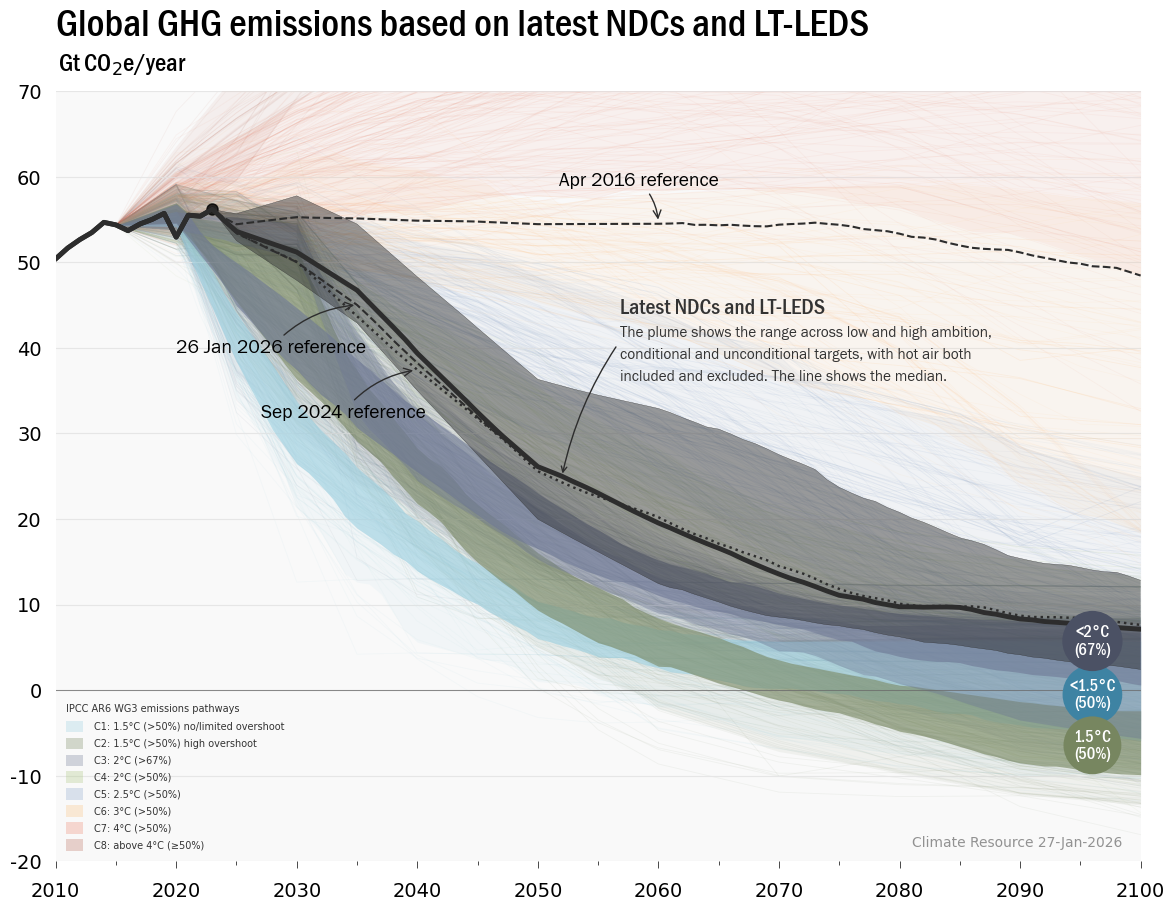
The 2035 NDCs matter because they anchor expectations about post-2030 policy direction and transition pathways. Taken together, the 2035 NDCs represent a meaningful signal of intent. In aggregate, they reaffirm countries’ commitment to achieving their long-term net-zero goals, with the marked exception of the US. Even in the current geopolitical context, the 2035 targets submitted over the last year in aggregate place global emissions on a trajectory that broadly aligns with a linear decline from 2030, to 2035 and beyond towards net-zero targets. This results in best estimates of global warming outcomes around 1.8 to 2.2 °C, taking into account the US withdrawal.
This represents a step change from outcomes implied by current policies alone, which remain clustered around 2.5 to 2.9 °C. The difference between these pathways reflects future policy tightening, accelerated deployment of clean energy, and capital reallocation across the global economy.
These 2035 targets will shape the policies, planning and investment that will be implemented to deliver on these commitments. They provide a guide to the sectoral decarbonisation pathways that will emerge. Understanding the emissions pathways at a country, regional, and global level is critical to identifying the policy needs, and investment opportunities and risks.
However, this improvement does not close the gap to ‘1.5 °C without overshoot’. The opportunity to limit warming to 1.5 °C throughout the century, without overshoot, has likely passed, unless emissions fall faster than is needed to meet 2030 targets. However, returning warming to 1.5°C by 2100 after overshoot remains technically feasible, provided existing targets are met in full, and ambition and implementation accelerate materially.
Land sector
In addition, we maintain a widely-used database of the land area pledged for sequestration in country NDCs and long-term targets. This has supported successive Land Gap Reports. It shows the extent to which pledges over-rely on land-based carbon dioxide removal to reach their net-zero goals. This risks insufficient near-term climate action in other sectors and highlights the need for more credible pathways to net zero.
Methodology
Our methodology for projecting emissions under country targets has been published in peer-reviewed publications, including Meinshausen et al. (2022), Realisation of Paris Agreement pledges may limit warming just below 2 °C https://www.nature.com/articles/s41586-022-04553-z , which appeared on the cover of Nature in 2023. Since then we have updated to input datasets, including those used for extrapolation to reflect more recent scenarios.
Licensing and access
Climate Resource makes this data available CC BY-NC 4.0 licence. It is freely available to students and for teaching purposes, and we make it available on commercial terms to others. We also provide additional data and data support services to clients wanting to use this for funded research or commercial purposes and wanting more frequent updates, metadata, analysis of changes over time, or to integrate these datasets into their workflows. Get in touch at contact@climate-resource.com if you are interested.
News about NDC Quantification
All newsNDC Quantification
Webinar 29 April 2026 - An updated global warming outlook: progress and perspectives from India
Read more
April 2026
Decarbonisation Futures
The last LNG train home
Short-term gas volatility masks a structural decline. As climate commitments reshape demand and cheap new supply comes online, Australia's expiring LNG contracts may mark the peak of its export era.

Read more
March 2026
NDC Quantification
Behind the Curves: Projected global emissions and warming taking into account India’s new (announced) 2035 target
India has announced its 2035 emissions target. We now have a more complete view of the course the world has set for the next 10 years and beyond to its net-zero goals.

Read more
Publications using NDC Quantification
All publicationsApril 2026
The last LNG train home
Dr. Anita Talberg, Karla Spiller, Rebecca Burdon, Dr. Alister Self, Dr. Mika Pflüger and 1 other

March 2026
Behind the Curves: Projected global emissions and warming taking into account India’s new (announced) 2035 target
Rebecca Burdon, Dr. Alister Self, Dr. Anita Talberg, Karla Spiller, Jared Lewis and 3 others