© 2010—2026 Climate Resource. All rights reserved.

MAGICC

Model for the Assessment of Greenhouse Gas Induced Climate Change

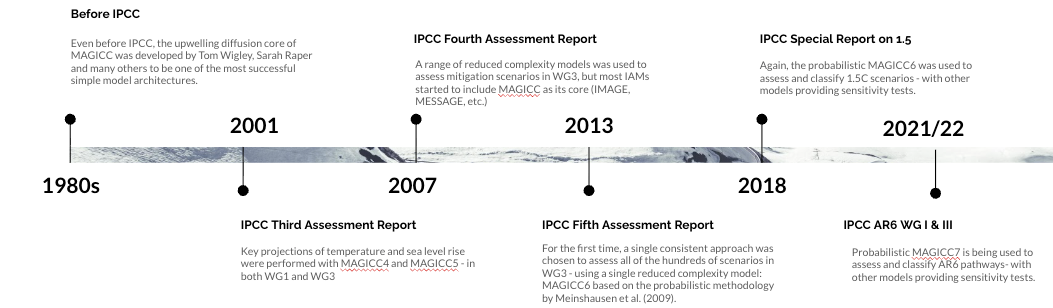
MAGICC translates emissions into global mean temperature rise. It is a prime reduced-complexity model, used by IPCC for successive assessment report cycles, for key scientific publications and by a number of Integrated Assessment Models. It is behind influential processes, such as the NGFS (Network for Greening the Financial System) scenarios.

MAGICC has been continually developed since its inception over 30 years ago. That development has been led by Climate Resource staff for many years.
MAGICC: translating emissions pathways into global mean temperature rise

MAGICC is used evaluate the temperature rise resulting from energy transition scenarios and integrated assessment models. It provides probabilistic projections of peak warming, end of century warming and the probability of exceeding a warming limit, such as 1.5°C, for a given emissions pathway.

MAGICC has been one of the most widely used reduced-complexity climate models in climate science research over the past 30 years, including by the IPCC.

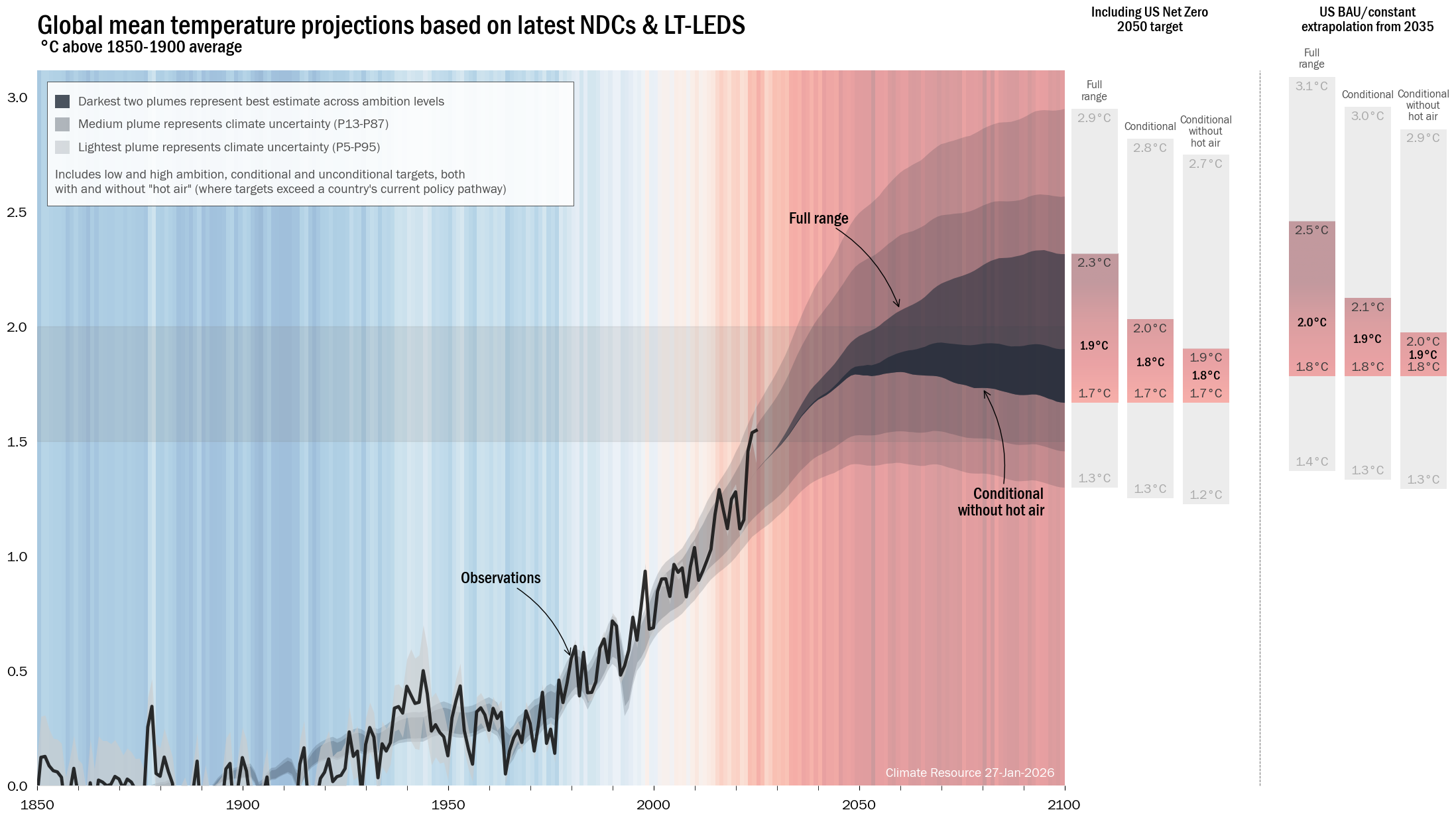
MAGICC is also used extensively by the international climate policy community to evaluate the warming implied by countries emission reduction targets, and to compare this to emissions under current policies. It enables us to project warming given country targets currently submitted to the UNFCCC - as in the chart shown here.

We find, consistent with other recent major assessments such as the UNEP Emissions Gap Report, that taking into account the impact of the U.S.A withdrawing from the Paris Agreement the best estimates of warming range from:

  • 2.5-2.9°C if emissions continue to reflect current policies
  • 2.3-2.6°C if emissions continue to reflect 2035 NDCs in the decades beyond 2035
  • 1.8-2.2°C if emissions reduce as needed to meet 2030, 2035 NDCs and long-term targets in full.

MAGICC is one of the most widely used reduced-complexity climate models in the climate science research and integrated assessment modelling communities over the past 30 years, including by the IPCC.

At Climate Resource, we build interfaces that enable clients to assess the temperature rise from the scenarios they construct and provide guidance to interpret the results.

This enables MAGICC to underpin the warming assessments in flagship publications, including successive IEA (International Energy Agency) World Economic Outlooks, McKinsey & Company's Global Energy Perspectives. It is used to support many reports and analyses by a range of professional services firms globally.

Methodology

MAGICC is a community reduced complexity climate model, which has a long history of over 30 years. It was developed by many individual across the globe, affiliated with numerous institutions.

Our staff at Climate Resource are the lead developers of MAGICC and continue to update and extend the underlying model. MAGICC is described in Meinshausen et al, (2011), with updates in Meinshausen et al. (2020). We are working on more up-to-date descriptions, and publications on these are forthcoming.

Licensing and access

We maintain an online non-commercial version for teaching and students with supporting resources at live.magicc.org.

We support a wide range of organisations to assess the warming implications of their emissions scenarios in a variety of ways. Our client specific interfaces enable:

  • Rapid scenario iteration
  • Consistency and data management
  • Comparisons to scientific, industry and policy scenarios.

For most clients, we build a bespoke interface to provide access to MAGIC and support services. The interfaces we construct take:

  • The outputs from client models
  • Infill missing species from scenarios ensembles produced by global scientific processes
  • Harmonise projections to historical emissions
  • Provide data management and version control for the MAGICC runs submitted.

Get in touch at contact@climate-resource.com if you are interested.

MAGICC: The climate system in a nutshell