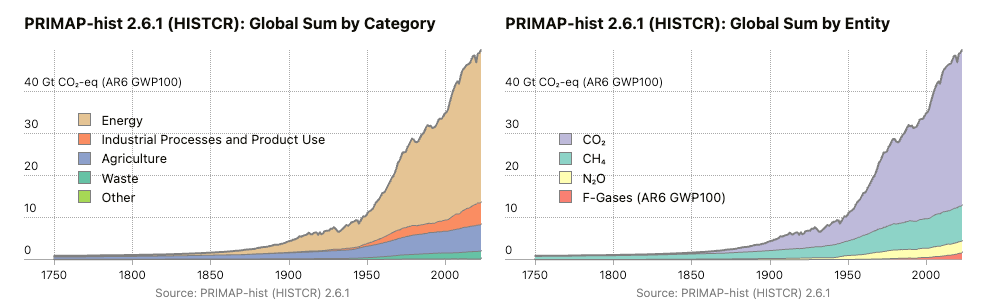
The PRIMAP-hist dataset combines several published datasets to create a comprehensive set of greenhouse gas emission pathways for every country and Kyoto gas covering the years from 1750 to 2024, and all UNFCCC (United Nations Framework Convention on Climate Change) member states, as well as most non-UNFCCC territories.

PRIMAP-hist
National historical emissions time series (1750-2024)
Effective responses to the impacts of climate change and the energy transition require credible, up-to-date data on historical and current emissions, and where the world is headed.
PRIMAP-hist is a core resource, delivering essential data. It provides high-quality, well maintained, up-to-date historical greenhouse gas emissions data that is:
- Comparable across countries
- Covers all sectors and gases
- Covers several years to decades
It builds on country-reported emissions, and combines this with third-party scientific datasets to derive a complete set and address missing data and unreported emissions.
PRIMAP-hist is a long-standing, highly cited composite dataset. It has long been widely used by the IPCC, the global science community, and international climate negotiators. It is increasingly used by the finance sector to evaluate the emissions intensity of their sovereign debt portfolios, including for reporting and assessment under:
- The PCAF (Partnership for Carbon Accounting Frameworks) method for sovereign debt
- The ASCOR (Assessing Sovereign Climate-related Opportunities and Risks) framework, developed by the Transition Pathway Initiative
Methodology
PRIMAP-hist comes in two variants, histCR, with country reported data used with highest priority, and histTP, with third party data used first.
PRIMAP-histCR starts from country-reported emissions data. Gaps in the country-reported data are filled using third-party data such as CDIAC, EI (fossil CO2), Andrew cement emissions data (cement), FAOSTAT (agriculture), and EDGAR 2024 (all sectors for CO2, CH4, N2O, HFCs, PFCs, SF6, NF3, except energy CO2). Lower-priority data are harmonised with higher-priority data in the gap-filling process. As the USA have not submitted any data to the UNFCCC this year we use the draft inventory report which the Environmental Defense Fund (EDF) obtained from the US Environmental Protection Agency (EPA) through the Freedom of Information Act.
PRIMAP-histTP - starts from third party priority time series, and gaps in these available datasets are filled from country reported data sources.
The methodology is described in full at www.PRIMAP-hist.org. The methodology is updated from time to time to take into account changes in country reporting obligations and practices and changes in third party input datasets.
Licensing and access
Climate Resource and our associate Dr Johannes Gütschow make this data available under the CC BY-NC-SA 4.0 licence. This means that the data can be freely used for non-commercial purposes as long as you provide adequate citations and share your derived results under the same licence. For other uses and commercial customers, we offer specific commercial licenses. We also provide additional data, and data support services to clients wanting more frequent updates, additional metadata or to integrate these datasets into their workflows. Get in touch if you are interested.
For commercial use, including by professional services firms, research providers, banks, insurance, investment companies and other financial institutions, other larger companies, multilateral organisations, and governments, please contact Climate Resource (primap@climate-resource.com).
For licenses for commercial use by NGOs and internal use by small companies, please contact Johannes Gütschow (commercial-support@johannes-guetschow.de).
Commercial use is defined as the use of the data for research or advice you have been contracted to provide, including the production of data or information you have derived from or that incorporates data or information obtained from this website for commercial purposes. This includes in the provision of data, advice or other services you have been contracted to provide, irrespective of whether you are a for-profit, or not-for-profit entity. It also includes the use of the data for investment decisions.
News about PRIMAP-hist
All newsJanuary 2026
PRIMAP-hist
One year on: How the US Paris exit reshapes global climate projections
Our new analysis reveals that global temperature projections by 2100 now fall into three distinct bands depending on policy implementation: 2.5-2.9°C under current policies alone, 2.3-2.6°C with 2035 NDCs, and 1.8-2.2°C when countries meet both their near-term commitments and long-term net-zero targets.

Read more
October 2025
PRIMAP-hist
New article in The Energy: What energy investment means for keeping warming below 2 °C
Our latest contribution to The Energy explores what recent temperature projections mean for the global energy transition.
Read more
October 2025
PRIMAP-hist
1.5°C is still alive, but only if countries step up
Australia’s newly announced 2035 emissions target of 62% to 70% below 2005 level comes at a critical moment for global climate action.

Read more
Publications using PRIMAP-hist
All publications
January 2026
Behind the curves - Comparing 2100 temperature projections and underlying assumptions
Dr. Anita Talberg, Dr. Alister Self, Jared Lewis, Karla Spiller, Prof. Malte Meinshausen and 2 others

October 2025
Pre-COP30: how are temperatures tracking on the latest climate targets?
Rebecca Burdon, Karla Spiller, Dr. Anita Talberg, Prof. Malte Meinshausen